Ten features, no upsell maze

Everything included in a VenueWebStudio website

Every feature of a VenueWebStudio website for wedding and event venues, banquet halls, barns and hotels with function space, and which of the three plans carries it.

Nothing below is an add-on with its own invoice. Every line states which of the three plans carries it, and the $697 build fee is charged only after your site is live and approved. Plans start at $127 a month.

Floor plan and capacity switcher

One control that swaps a room between seated dinner, theatre, cocktail and ceremony, with a plan and figures for each.

Why a static floor plan photo is not enough

A single photo of an empty room forces a couple or a planner to imagine four different layouts from one angle. The switcher shows the same room set for a seated dinner, a theatre-style talk, a cocktail reception and a ceremony, each with its own inline diagram and its own set of capacity figures, so the question "will our group fit" gets answered on the page instead of in a phone call.

How it is built

The switcher is a lightweight control, not a video or a downloadable PDF, so it loads instantly and works the same on a phone at a coffee shop as it does on a laptop. Every figure shown is clearly labelled as an example for that room until your real numbers are supplied during onboarding, so nothing on the page ever states a capacity as fact before you have confirmed it.

What you provide

You give us the dimensions or existing floor plan for each room and the layouts you actually offer. We turn that into the inline diagrams and swap in your real capacity numbers once you confirm them, replacing the illustrative placeholders shown during the build.

Available on The Walkthrough, Booked Solid, Every Season

Pages that open instantly

Custom-coded pages served from the edge, 90+ PageSpeed guaranteed.

Why speed is the first feature on a venue site

A couple comparing five venues on a Sunday night does not wait for a slow page to finish loading photos before moving to the next tab. Every page is custom coded, ships almost no JavaScript, and is served from a global edge network, so the site is fast on the day it goes live rather than after someone eventually audits it.

What 90+ PageSpeed actually protects

A 90 or higher PageSpeed score is not a vanity number, it is what keeps a gallery-heavy venue page from stalling on a phone with a weak signal at a bridal show or an outdoor site visit. We guarantee the score and keep it there as photos and pages are added, rather than letting it drift down over a year of uploads.

Available on The Walkthrough, Booked Solid, Every Season

Availability and inquiry calendar

A calendar-style inquiry flow that captures the date, the headcount and the layout before it reaches you.

What the calendar solves

The most common reason a venue inquiry goes nowhere is a form that only asks for a name and a message, leaving the actual date and guest count to a follow-up email that gets missed. The inquiry flow asks for the date, the approximate headcount and the layout in mind up front, so the first message a coordinator sees already has what is needed to answer.

Where the inquiry goes

Every inquiry is delivered into the CRM, inbox or scheduling tool you already use, connected by direct API, Zapier or Make. Nothing sits in a form plugin waiting to be checked, and nothing requires you to learn a new system just to see who asked about a date.

Available on The Walkthrough, Booked Solid, Every Season

Room and package pages

A dedicated page for every room and every package, so search engines and visitors both have something specific to find.

Why one page per room

A single "our venue" page cannot rank for or clearly answer questions about a specific ballroom, garden or barn on the same property. Each room or package gets its own page with its own floor plan, photos, capacity information and included items, so someone searching for that specific space finds a direct answer instead of a paragraph buried in a longer page.

What a room page includes

Each page carries the room name, the layouts it supports, what is included at that tier of package, and the photos specific to that space. Packages are laid out so a comparison between them is a glance rather than a phone call, while every page still ends in the same clear next step: check the date.

Available on The Walkthrough, Booked Solid, Every Season

Local and organic search visibility

Pages, structure and researched articles built to rank for the venue searches happening in your area.

What actually moves a venue up in search

A venue ranks for the searches that matter when the site has a genuine page for each room, each layout and each nearby area it serves, built with the technical basics search engines expect: fast pages, correct structured data and a clear page structure. There is no shortcut that replaces having real, specific content to rank.

Structured data on every page

Every page carries the structured data appropriate to its content, from the organization details on the home page to the offer information on pricing, so search engines and AI answer tools can read what the page actually says rather than guessing from the visible text alone.

Available on The Walkthrough, Booked Solid, Every Season

The AI Engine

Trained AI agents that answer common venue questions and take inquiry details after hours, included from tier two.

What it answers, and what it hands off

The AI Engine is trained on your rooms, capacities, packages and policies so it can answer a common question at 9pm on a Saturday, such as whether a date is worth inquiring about or what a package includes, and capture the details of a genuine inquiry so nothing waits until Monday. It is configured to hand off, never to invent an answer, and it never gives licensing, fire-safety or capacity-compliance advice.

Why it takes longer to launch

Training the agents on your specific rooms and policies is why tier two launches in more days than tier one. The extra time goes into making sure the agent answers from your real information rather than a generic script.

Available on Booked Solid, Every Season

The Content Engine

The highest volume of researched articles, for venues that want to own every seasonal and local search term.

What the extra volume buys

Every plan includes researched articles every week. The Content Engine on the top tier increases that volume so a venue can cover more seasonal topics, more nearby areas and more event types across a year without waiting as long between publishes, which compounds the local and organic visibility built by the rest of the site.

Available on Every Season

Managed hosting and uptime

Hosting, SSL, a CDN and DDoS protection included in the monthly fee, with nothing itemized separately.

What is included and what is not billed

Hosting runs on a global network with SSL, a content delivery network, DDoS protection and unmetered bandwidth included in the monthly fee. There is no separate hosting invoice, no SSL renewal to remember and no bandwidth overage charge during a busy engagement season.

Available on The Walkthrough, Booked Solid, Every Season

Inquiry routing to your CRM

Every form and calendar inquiry connected to the system you already run your bookings from.

Connected on day one

Inquiries are connected to your CRM by direct API, Zapier or Make during onboarding, so a new lead lands where your team already works rather than in an inbox that only one person checks. If you do not have a CRM yet, we set up a simple destination so nothing is lost while you decide on a longer-term system.

Available on The Walkthrough, Booked Solid, Every Season

Speed as money

A fast page is a cheaper page to advertise

Every plan commits to a 90+ PageSpeed score at launch, and keeps it there as your photographs and pages are added. That is not a vanity number, it is the condition the rest of this section depends on.

Committed in writing

90+

Google PageSpeed, mobile and desktop, guaranteed on the pages we build and host. If a page falls below it because of our work, we fix it at no charge.

How we keep it there
  • You already paid for the click

    Every visitor from an ad, a directory listing or a bridal show flyer cost you something before they arrived. If the gallery is still loading when they lose patience, that money is spent and nothing came back. A page that is usable immediately keeps more of the traffic you are already buying.

  • Google weighs the landing page in the auction

    Google states that Ad Rank calculations can include auction-time quality measurements such as expected click-through rate, ad relevance and landing page experience, and that higher quality ads can often lead to lower cost per click. A faster, more relevant venue page is therefore one of the levers you control. We will not promise you a number, because nobody honestly can.

  • The phone is the hard case, not the exception

    A couple comparing venues is usually on a phone, often on a weak signal, often between other things. Google advises advertisers to improve landing page loading speed and to make the site mobile friendly, and says the speed a page loads at can be the difference between someone bouncing or buying. That is the visitor we build for first.

  • The same work helps the traffic you do not pay for

    Google says its core ranking systems look to reward content that provides a good page experience, while also being clear that there is no single page experience signal. Speed is not a shortcut to ranking. It is one of the conditions that stops good content being held back.

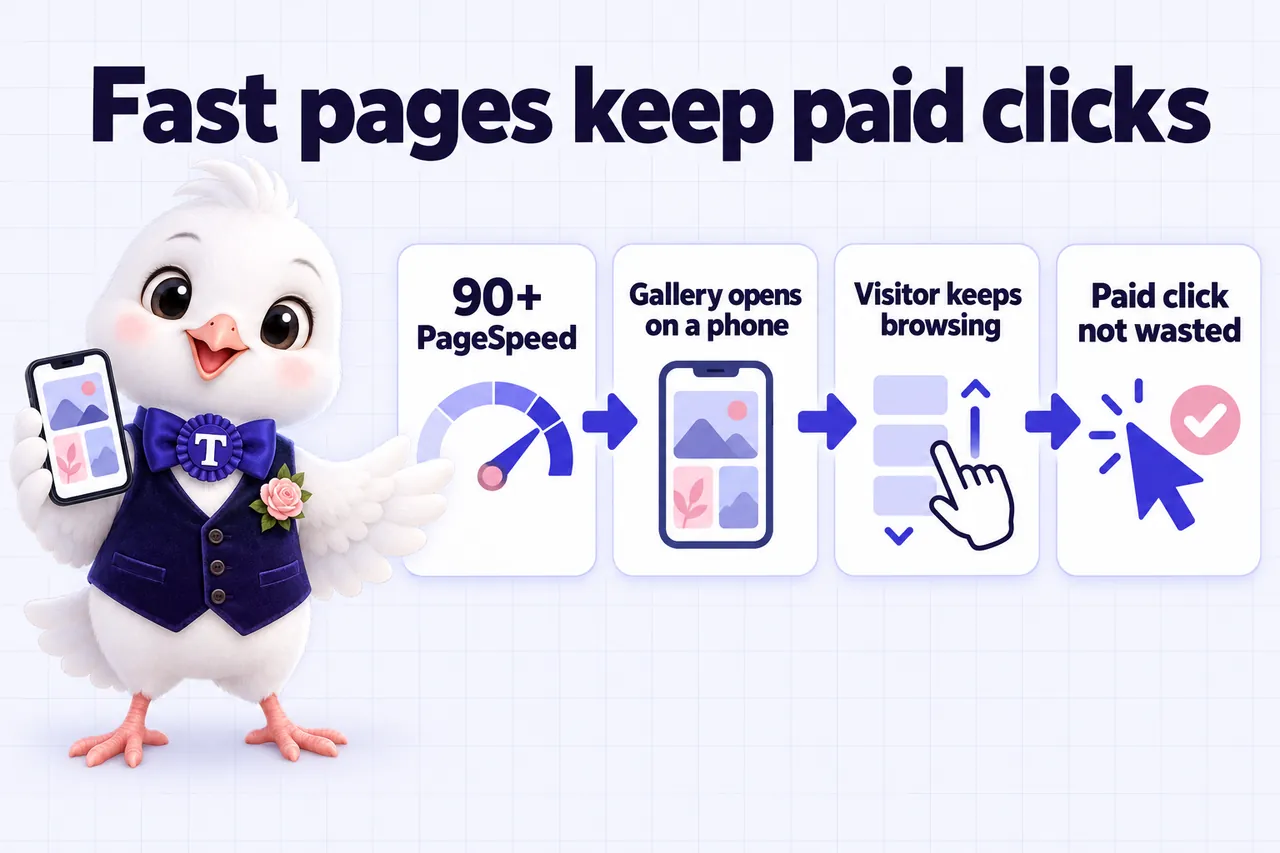
Infographic: Fast pages keep paid clicks. 90+ PageSpeed, then the gallery opens on a phone, then the visitor keeps browsing, so the paid click is not wasted. Tulle holds up a phone.

Where these statements come from

We make no claim about what your cost per click will be, and no claim about rankings. Google's own Quality Score documentation notes that Quality Score is a diagnostic tool rather than an input in the ad auction, which is why the argument above is about landing page experience inside Ad Rank instead.

Being found

SEO, AEO, GEO and schema, in plain terms

Four different jobs, all included on every plan. Here is what each one means for a venue, what we build, and what it honestly does not promise.

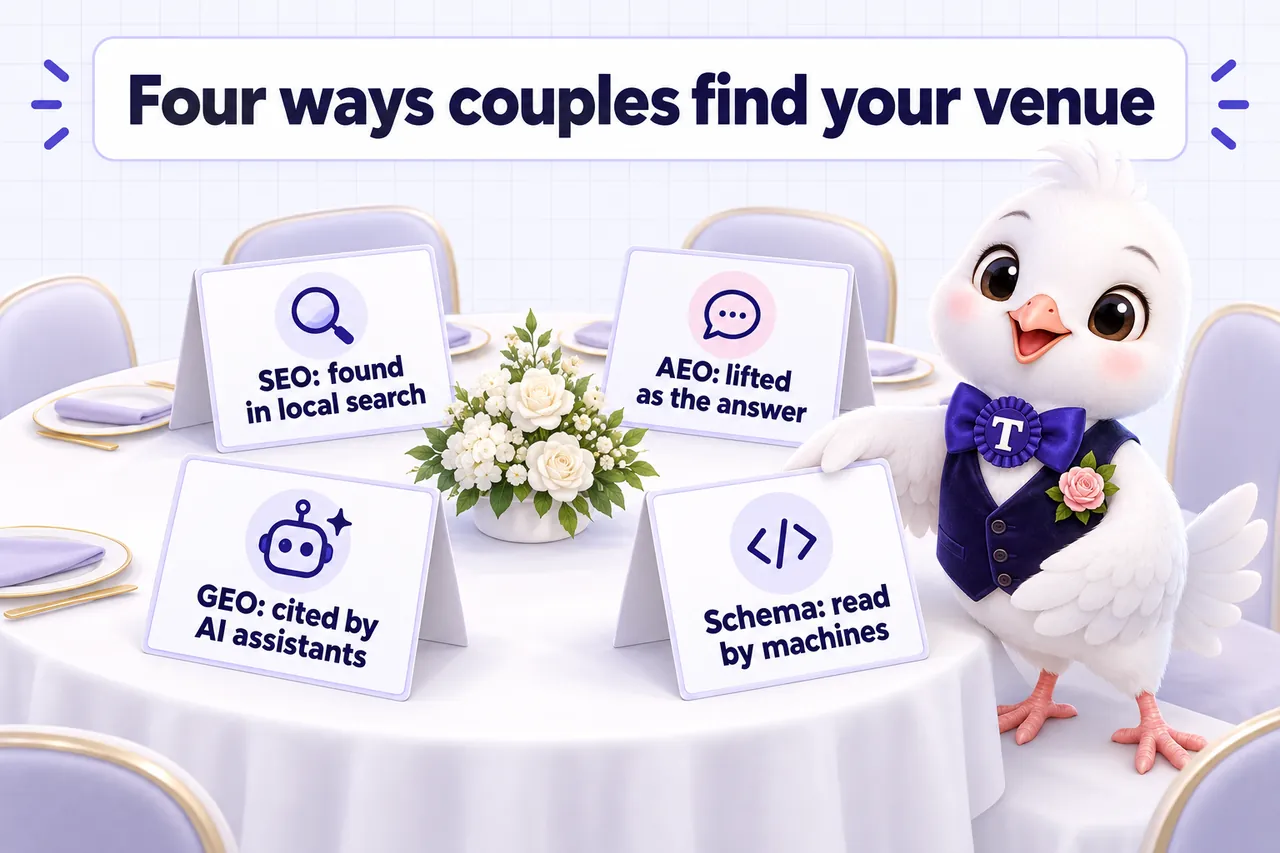
Infographic: Four ways couples find your venue, shown as place cards on a banquet table. SEO: found in local search. AEO: lifted as the answer. GEO: cited by AI assistants. Schema: read by machines.
SEO

Search engine optimization

Being found by someone typing the name of your town next to the words wedding venue.

  • The technical layer: clean page structure, correct headings, fast pages, a sitemap that updates itself and a robots file that lets the right crawlers in.
  • The on-page layer: a unique title and description for every page, one main heading per page, and content that answers the question the page is named after.
  • Service area pages for the cities and counties your venue genuinely draws from, so a search for a venue near a specific town has a page to land on.
  • 2 to 3 researched articles a week, 2,500 to 3,200 words, so the site keeps giving search engines something new that is worth ranking.

Not a ranking guarantee for a term outside your area or your services, and not a shortcut around having real pages worth finding.

AEO

Answer engine optimization

Being the answer that gets lifted out of the page, in a featured snippet, a voice result or an AI summary.

  • Answer-first writing: the first sentence under a heading answers the heading, rather than warming up to it in paragraph four.
  • Question-shaped headings that match how a couple or a planner actually asks, such as how many people the room seats for a seated dinner.
  • A visible FAQ block on every significant page, with the same text marked up so an engine can read it as questions and answers.
  • Clean comparison tables and definition lines that can be lifted whole without losing their meaning.

Not a promise of a snippet. Engines choose; we make the page the easiest thing to choose.

GEO

Generative engine optimization

Being cited by assistants such as ChatGPT, Claude, Perplexity and Google AI Overviews when someone asks them about venues in your area.

  • Plain-text feeds at llms.txt and llms-full.txt describing the business, what it offers and where, in the format these tools expect.
  • Consistent naming: the same venue name, the same room names and the same package names on every page, so an assistant can attribute facts to one entity.
  • Facts stated plainly and attributably, with dates on the page, because a quotable sentence is what gets quoted.
  • A robots file that welcomes the AI crawlers rather than blocking them, which is a decision you can reverse at any time.

Nobody can guarantee an appearance in an AI answer. What we can do is make your venue the clearest, most citable source about itself.

Schema

Structured data

The machine-readable summary underneath each page, telling search engines exactly what they are looking at.

  • Organization and local business details, so your name, contact route and service area are unambiguous.
  • Service markup on the pages that describe what you sell, and breadcrumb markup so results show where a page sits.
  • FAQ markup generated from the questions actually visible on the page, never from hidden text.
  • Review markup only when there are real, permissioned reviews to mark up. Sample or illustrative quotes never generate review data.

Structured data does not buy a ranking. It removes the guesswork, which is what makes rich results possible.

Assistants and search engines are named here as plain text only. We are not affiliated with any of them, and nothing on this site implies endorsement.

What ships with it

The policy pages your website comes with

Built with your site rather than pasted in afterwards. They help you meet the obligations a venue website carries. They are not legal advice, and no website can guarantee compliance with any statute.

  • Privacy policy

    Written for a US venue that collects inquiry details: what is collected on the inquiry form, why, who it is shared with, how long it is kept and how someone asks for it to be removed. It names the state privacy laws that commonly apply, including CCPA and CPRA in California, the Virginia CDPA, the Colorado Privacy Act.

  • Terms of use

    The terms for using the website itself, kept separate from your venue contract so the two never contradict each other. Your booking terms, deposit schedule and cancellation policy stay yours and are linked rather than rewritten.

  • Cookie policy, with consent that actually gates scripts

    The policy lists the cookies the site really sets, and the banner controls whether analytics and marketing tags load at all rather than only recording a preference. A banner that blocks nothing is worse than none.

  • Accessibility statement

    States the standard the site is built to, WCAG 2.2 AA, what was done, the known limits, and how a visitor reports a problem. The build itself carries the practices behind it rather than the page standing alone.

  • Consent wording on forms that ask for a phone number

    If your inquiry form collects a mobile number and your team texts back, the form carries clear consent wording and a way to opt out, written with US marketing and messaging rules in mind. What you then send is your call, and it stays your responsibility.

  • Clear statements of what your venue is and is not

    Capacity figures shown on your site are labelled as your confirmed numbers or as example data for illustration until you sign them off, and the AI Engine is configured never to give licensing, fire-safety or capacity-compliance answers. Those questions go to a person at your venue.

Where your venue has a specific legal obligation, take advice from a qualified professional. You can see how we handle our own on the privacy policy, cookie policy and accessibility statement for this site.

Features in use

What these features changed for three venues

Each quote names the specific feature the venue is talking about.

  • Submission acknowledgment and follow-up for event space inquiries
    People used to call just to check their event space inquiries form had actually gone through. Now the sender gets a summary, the next step in plain language, and a way to correct mistakes. A modest change with an outsized effect on our mornings.
    Daphne BarlowDuty manager, Racecourse events suiteOmaha, NE
  • Inquiry assignment and staff handover for event space inquiries
    Event space inquiries messages used to belong to everyone, which meant they belonged to no one. Requests are assigned automatically, with a backup for when the owner is away. The website and our way of working finally match.
    Rashid ShiraziFunctions coordinator, Woodland ceremony venueOverland Park, KS
  • Location information and contact routing for event space inquiries
    The event space inquiries page used to describe everything and route nothing. The visitor picks their location once, and it follows the message all the way to the reply. The 'let me transfer you' routine has almost disappeared.
    Phyllis SatterfieldShowround bookings lead, Coastal ceremony and reception venueManchester, NH

Feature availability by plan

The same ten features, laid out as a grid. Every plan carries the floor plan switcher, the room pages, the hosting and the weekly articles; the difference between tiers is speed to launch, after-hours AI answering and article volume.

FeatureThe WalkthroughBooked SolidEvery Season
Floor plan and capacity switcher
Pages that open instantly
Availability and inquiry calendar
Photo and virtual tour gallery
Room and package pages
Local and organic search visibility
The AI Engine
The Content Engine
Managed hosting and uptime
Inquiry routing to your CRM

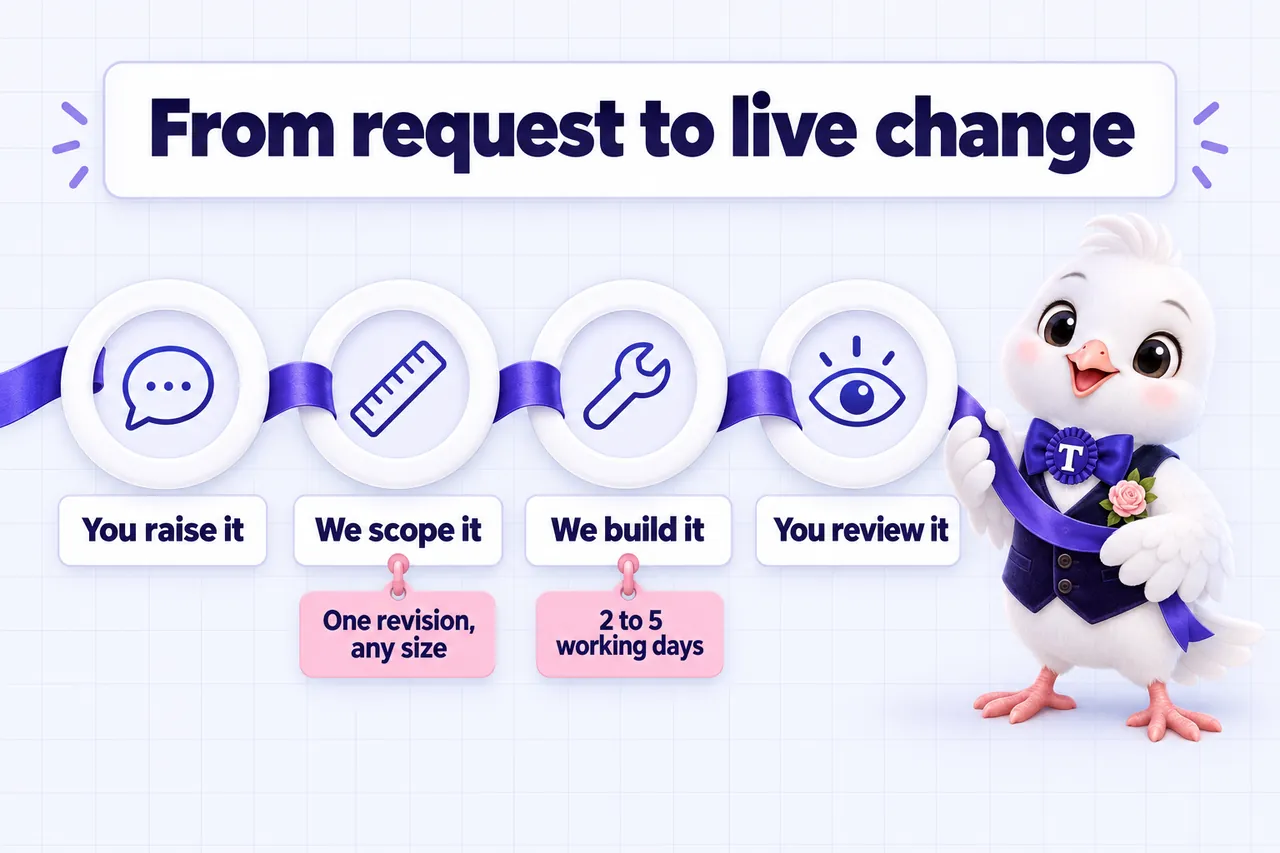
How a feature request becomes a live change

1

You raise it

In your client portal, or by email.

2

We scope it

One revision, whatever the size.

3

We build it

Turned around within 2 to 5 working days.

4

You review it

Live once you approve.

Infographic: From request to live change. You raise it, we scope it (one revision, any size), we build it (2 to 5 working days), you review it.

Feature questions

What does a VenueWebStudio site actually include?

A room-by-room site built around your floor plans, capacity, packages and availability, on The Walkthrough, Booked Solid or Every Season. Every plan includes managed hosting, 5 revisions a month, 2 to 3 researched articles a week depending on tier, and a floor plan and capacity switcher for your rooms. The $697 one-time build fee is invoiced only after your site is live and approved.

How long until our venue site is live?

7 days on The Walkthrough, 10 on Booked Solid while the AI agents are trained on your rooms and policies, and 15 on Every Season with the content engine running from launch. The clock starts once your onboarding call is done, so the sooner your floor plans and photos are in, the sooner the room pages go live.

Where do you work? Are you limited to certain states?

We build for venues anywhere in the United States. Everything happens over a call, a form and your client portal, so where the venue sits changes the content rather than the service. Venues in Texas, California, Florida, New York, Illinois, Georgia, North Carolina, Pennsylvania, Arizona and Ohio ask most often, but the list is not a limit.

How do you compare with a builder, a freelancer or an agency?

There are ten comparison pages covering GoHighLevel funnels, the GoHighLevel website builder, GoHighLevel AI Studio, WordPress, Wix, Squarespace, Webflow, GoDaddy Website Builder, hiring a freelancer and using a venue marketing agency. Every one of them has a section stating plainly when that option is the better buy for a venue. If one of them fits you better, we would rather you read it there than find out later.

Are the client quotes on this site real reviews?

Yes. Every quote is a real statement from a named client, published with their permission, and each one names the person, their role, the kind of venue and the city. The venue itself is not named, on purpose. There is no star rating and no review count anywhere on the site, because none was collected, and the case studies follow the same rule.

Can the site handle more than one property or more than one hall on the same property?

Yes. Multiple rooms, halls or properties each get their own page with their own floor plan, capacity figures and photos, and the mega menu and site structure are built to carry that many pages without turning into a maze. Tell us your room count during onboarding so it is planned into the build from the start.

What can the AI Engine actually answer for us?

Common questions such as whether a date is worth inquiring about, what a package includes, or what capacity a room holds in a given layout, all trained on your real rooms and policies rather than a generic script. It captures the details of any genuine inquiry that comes in outside business hours so nothing waits until Monday, and it hands off rather than guessing when a question needs a person.

Will the AI Engine ever give advice about our venue license or capacity limits?

No. It is configured never to give licensing, fire-safety or capacity-compliance advice, and never to state a firm capacity figure as fact beyond what you have confirmed. Anything of that nature is handed to a person at your venue. The AI Engine is included on Booked Solid and Every Season.
Ready to see it on your rooms?

Book a demo