A history section with real narrative space
A dedicated page telling the estate's actual history and architectural detail, supporting the booking decision rather than replacing it.
Historic estate venue website design has to do two things a standard venue site does not: tell a compelling story about the building's history, and prove, just as clearly, that the estate is genuinely set up to host a modern wedding or event today, with restrictions and rules stated plainly rather than buried in a contract discovered later.
What it costs
A historic estate's story, who built it, what era it belongs to, what makes the architecture distinct, is genuinely part of what draws a couple to book it, and design gives that story real space rather than reducing it to a single caption. But the homepage still leads with the same first questions any venue buyer has: what does the room look like set for an event, and how do we check a date, with history supporting that decision rather than replacing it.
Photography and page structure work together to show that the estate, despite its age, handles catering, AV, seating and modern event logistics competently: a reception layout inside a heritage room, a tent or covered structure on the grounds, load-in access for vendors. Without that, a couple can assume a beautiful historic building is impractical for an actual wedding, which costs the estate bookings it could otherwise win.
A dedicated page lists vendor restrictions, decor limits and load-in rules plainly, framed around what protects the property's historic character rather than as an arbitrary list of no's. Couples who are already drawn to a heritage venue tend to respect that framing, and stating the rules clearly before a tour saves both sides the friction of discovering them mid-negotiation.
The temptation with a historic property is to lean entirely into ornate, old-fashioned web design, script fonts, sepia tones, heavy borders, but a site can honor the estate's character with a restrained, modern layout: clean typography, real photography doing the storytelling, and a period-appropriate accent color used sparingly rather than applied to every element on the page.
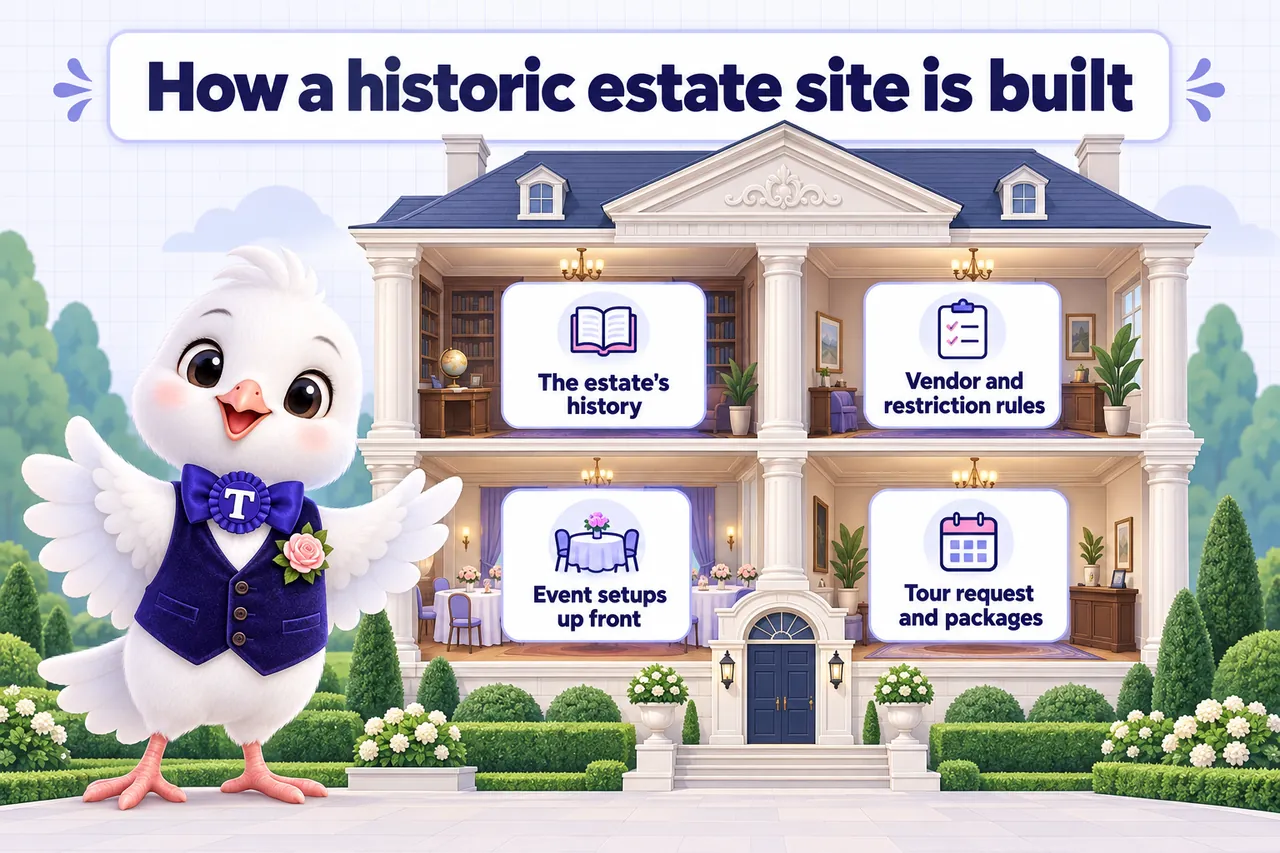
A dedicated page telling the estate's actual history and architectural detail, supporting the booking decision rather than replacing it.
Real event setups shown inside and around the historic structure, addressing the "can this actually host our wedding" question directly.
Rules on vendors, decor and load-in stated plainly and framed around preserving the property, not as a list of arbitrary limits.
Local permit, noise and curfew information relevant to booking, written clearly rather than reproduced from a municipal document.
Clean typography and a period-appropriate accent color used sparingly, avoiding an overly ornate or dated look.
A clear way to book a tour and see package pricing, since heritage properties often require a guided, docent-led visit.
The old event space inquiries PDF made sense on a printer and nowhere else. The content is the same material, reorganized into headed sections that work on any screen. A printable copy still exists for those who ask.
The review of our event space inquiries pages was uncomfortable reading, in a useful way. Everything now lives in one maintained reference, with the duplicates retired or redirected. Customers no longer quote wording we retired two years ago.
I wanted the event space inquiries page to show how we work, not just assert that we work well. Everything published is material we reviewed ourselves, chosen because it answers a real question. People comment on it, which never happened with the old page.
Yes. The restrictions page is written to frame rules around protecting the property's historic character, the same reason a couple wants to book it, rather than as a bare list of prohibitions. Couples drawn to a heritage venue generally respond well to that framing.
That is a specific design goal for this niche. Photography and page structure are built to show real event setups, catering, seating, AV, inside the historic space, since a couple who only sees architectural photos may wrongly assume the venue cannot support a full modern event.
No. VenueWebStudio is a website design and management company, not a preservation consultant or permitting authority. We build the pages that present your restrictions and permit information clearly; compliance and actual permit approvals remain your venue's responsibility.
The same as any other venue build: plans start at $127 a month with a one-time $697 build fee invoiced after launch. A historic estate site sometimes uses more of the included monthly revisions early on to refine the history section, but the base pricing does not change.
There are 10 comparison pages covering builders, platforms, freelancers and agencies. Each one has a section stating plainly when that option is the better buy for a venue.
A live walk-through of the site you would get, in about 30 minutes. Plans from $127 a month, the $697 build fee invoiced only after launch, domain and hosting included.
Book a demoOr email and a person replies within one working day.
VenueWebStudio uses the cookies below. Necessary cookies keep the site working and cannot be turned off.
Saved on this device only. Press Esc to close.