A dedicated page per property
Its own address, gallery, room details and capacity information, distinct enough to rank on its own in local search.
Multi-location venue website design solves a specific problem: a group running two or more properties needs each location to rank in its own city and read as a real, specific venue, not a copy-pasted page under a shared brand shell. That means a shared design system across locations, but a dedicated page, gallery and local details for each one.
What it costs
Every property gets its own page with its own address, photography, room details and capacity information, rather than one generic "locations" list that sends visitors to a shared page with a swapped city name. A searcher looking for a venue in one specific city needs to land on a page that is clearly about that city's property, its rooms and its team, not a diluted overview of the whole group.
Search engines penalize pages that are nearly identical to each other by simply ranking none of them particularly well, which is what happens when location pages are built by copying one template and swapping only the city name. Each location page needs enough distinct content, its own photos, its own room names, its own local details, to read as genuinely different from its sister locations rather than a duplicate with find-and-replace.
The brand look, palette, type, navigation, stays consistent across every property so the group reads as one business, but each location's content is managed independently: pricing, availability and photos update per property without affecting the others. A change at one location, a sold-out season or a new room, never accidentally shows up on a different property's page.
A group homepage gives an overview and a clear way to choose a location by city, but the real selling happens on each property's own page. That structure keeps the group brand coherent while still giving each individual venue the dedicated space it needs to rank locally and convert its own inquiries.
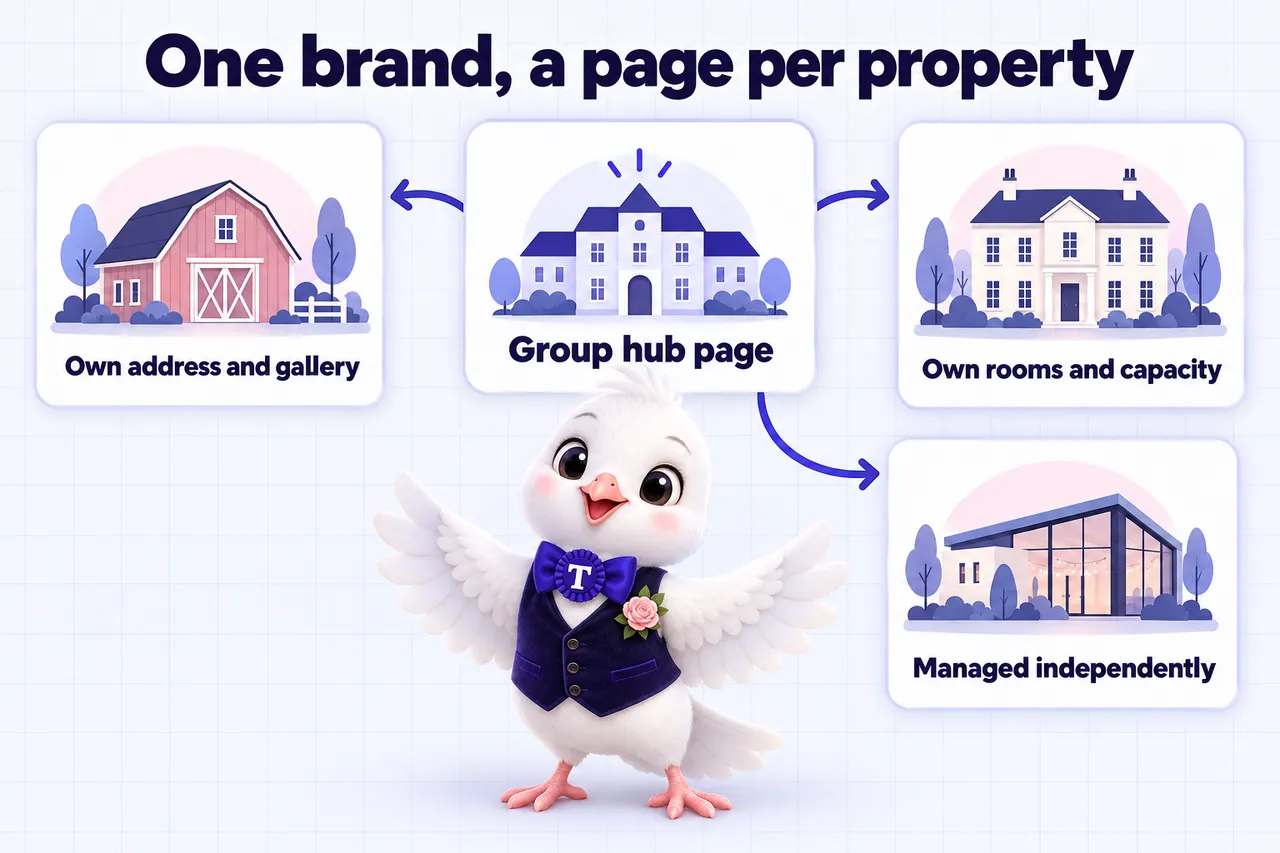
Its own address, gallery, room details and capacity information, distinct enough to rank on its own in local search.
Real local information for every property, avoiding the copy-pasted, city-name-swapped pages that search engines rank poorly.
A shared palette, type and navigation so the group reads as one business while each page stays distinct in content.
A homepage overview that routes visitors to the correct property by city, without diluting each location's own ranking potential.
Pricing, availability and photo updates handled per property, so a change at one location never affects another.
The old event space inquiries PDF made sense on a printer and nowhere else. The content is the same material, reorganized into headed sections that work on any screen. A printable copy still exists for those who ask.
The review of our event space inquiries pages was uncomfortable reading, in a useful way. Everything now lives in one maintained reference, with the duplicates retired or redirected. Customers no longer quote wording we retired two years ago.
I wanted the event space inquiries page to show how we work, not just assert that we work well. Everything published is material we reviewed ourselves, chosen because it answers a real question. People comment on it, which never happened with the old page.
Each location should be able to rank on its own, since a searcher looking for a venue in one city is not helped by a page mostly about a different city's property. A shared site with genuinely distinct pages per location is how a group ranks in every market it operates in rather than just its headquarters city.
They can share a general pricing structure across the group, but each location's page should state its own actual pricing, availability and room details, since those often differ property to property even under one brand.
A new property is added using the same design system already built for the group, so it launches with a consistent look and its own dedicated page rather than requiring a separate site build from scratch.
Pricing is quoted per site rather than per location as a flat multiplier, since the right plan depends on how many properties are involved and how much content each needs. Every plan still starts from the same base, $127 a month per site with a $697 build fee, invoiced after launch.
There are 10 comparison pages covering builders, platforms, freelancers and agencies. Each one has a section stating plainly when that option is the better buy for a venue.
A live walk-through of the site you would get, in about 30 minutes. Plans from $127 a month, the $697 build fee invoiced only after launch, domain and hosting included.
Book a demoOr email and a person replies within one working day.
VenueWebStudio uses the cookies below. Necessary cookies keep the site working and cannot be turned off.
Saved on this device only. Press Esc to close.