A structured booking inquiry form
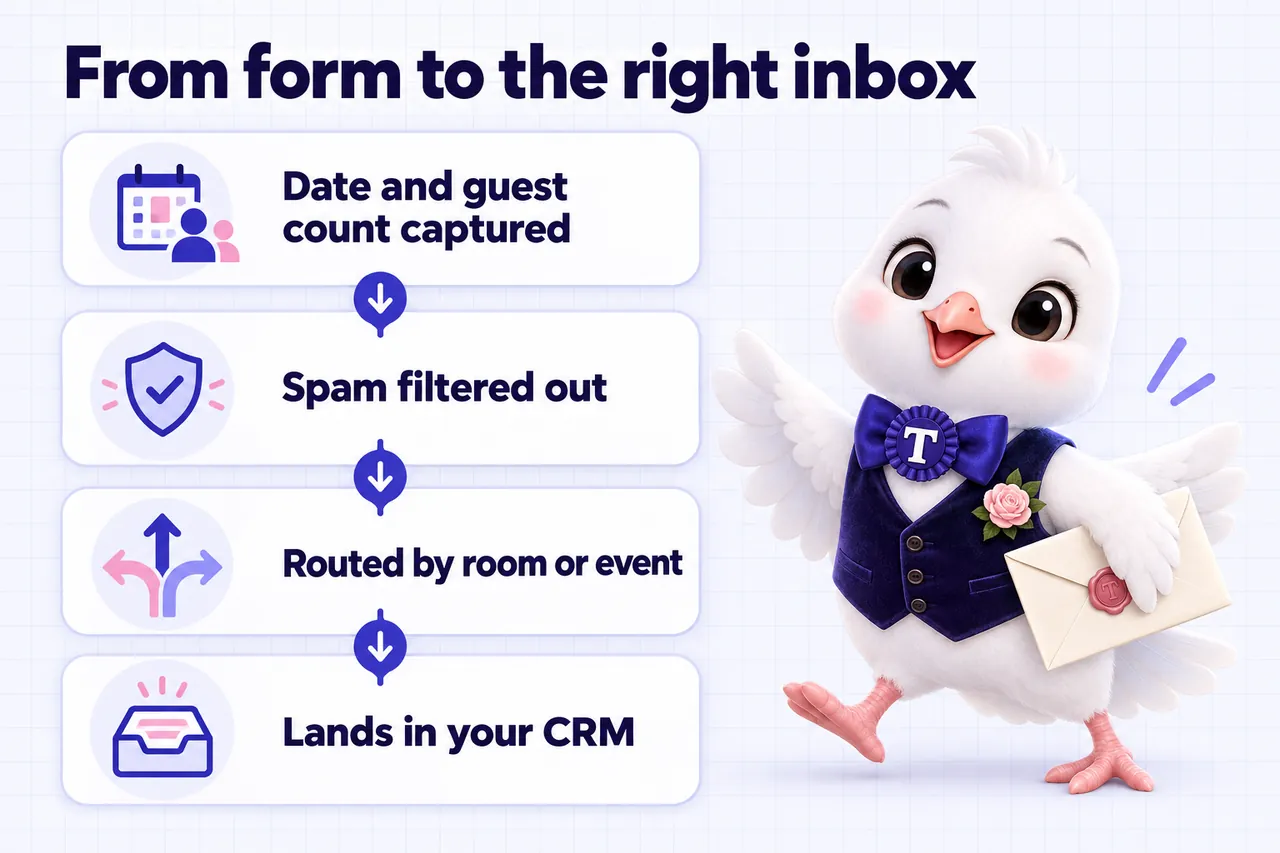
Date, guest count, event type and room preference captured upfront, built to reduce back-and-forth before a quote can go out.
Venue booking website development means building the actual mechanics behind an inquiry, date checking, guest count capture, routing to the right person, into the site itself, rather than dropping a generic contact form onto a page and hoping the right details come through. A booking-focused build reduces the back-and-forth emails needed before a venue can even send an accurate quote.
What it costs
Instead of a generic name, email, message form, the booking flow captures date, guest count, event type and room preference upfront, the exact details a venue needs to send back a real answer instead of a "let's schedule a call to discuss" reply. That structure alone often cuts a full round of back-and-forth email out of the inquiry process.
Where a venue wants it, the build includes a lightweight availability view, showing which dates or seasons are open, so a couple or planner can self-screen before submitting an inquiry. That reduces the number of inquiries for dates that were never going to work, which saves staff time on both sides of the conversation.
Once submitted, an inquiry can route to a specific email, a shared inbox, or into a CRM the venue already uses, depending on event type or room, so a corporate inquiry does not sit in the same queue as a wedding inquiry waiting for the same person to notice it. Development includes setting up that routing correctly during onboarding, not leaving it as a generic form-to-inbox default.
Booking inquiries often spike around specific seasons, engagement season for weddings, budget season for corporate events, and the build is developed to handle that traffic without slowing down or dropping submissions. Fast, reliable hosting is included as part of the monthly plan rather than something a venue has to separately manage or upgrade during a busy month.
Date, guest count, event type and room preference captured upfront, built to reduce back-and-forth before a quote can go out.
A way for a couple or planner to see open dates or seasons before submitting an inquiry, cutting down on dead-end requests.
Submissions sent to the right inbox, email or CRM automatically, based on what was booked and which room it involves.
Reliable, fast hosting included in the plan, developed to stay responsive during your busiest inquiry periods.
Basic protection built into every inquiry form so staff time is not spent sorting through junk submissions.
Form fields, routing rules and availability views can be adjusted under the monthly revisions included on every plan.
The old event space inquiries PDF made sense on a printer and nowhere else. The content is the same material, reorganized into headed sections that work on any screen. A printable copy still exists for those who ask.
The review of our event space inquiries pages was uncomfortable reading, in a useful way. Everything now lives in one maintained reference, with the duplicates retired or redirected. Customers no longer quote wording we retired two years ago.
I wanted the event space inquiries page to show how we work, not just assert that we work well. Everything published is material we reviewed ourselves, chosen because it answers a real question. People comment on it, which never happened with the old page.
In most cases, yes. If your venue already uses a CRM with an email-based or webhook-based intake, the booking form can be configured to route submissions there during onboarding, alongside or instead of a shared inbox.
It can, if your calendar supports it, or it can run as a simpler view you update directly through your monthly revisions if it does not. Either way, the goal is giving a visitor a realistic sense of open dates before they submit an inquiry, not necessarily a live two-way sync.
That depends on your own team's process rather than the site itself, since the site's job is capturing and routing the inquiry correctly. We can set up an automatic confirmation reply to the couple or planner so they know the inquiry was received while your team follows up.
Booking and routing functionality is part of the standard build, included in plans starting at $127 a month with the one-time $697 build fee, not an add-on charged separately.
There are 10 comparison pages covering builders, platforms, freelancers and agencies. Each one has a section stating plainly when that option is the better buy for a venue.
A live walk-through of the site you would get, in about 30 minutes. Plans from $127 a month, the $697 build fee invoiced only after launch, domain and hosting included.
Book a demoOr email and a person replies within one working day.
VenueWebStudio uses the cookies below. Necessary cookies keep the site working and cannot be turned off.
Saved on this device only. Press Esc to close.